

Dance Studio Flooring: How to Choose the Right Floor
Dance studio flooring is two systems working together: a sprung subfloor that absorbs impact, and a vinyl performance surface on top that controls grip. Get both right and the floor protects dancers' joints, suits every class on the timetable and lasts for years. This guide walks through choosing the surface by dance style, the installation options, preparing the subfloor and what drives the cost of a new floor.

Start with the classes you teach
Rosco's own advice is that the dance styles in a studio decide the floor. Soft shoe styles such as ballet need controlled grip for turns. Hard shoe styles such as tap need a surface that is tough enough for metal taps and gives a clean sound. Rosco's floor chart maps each style to the floors that suit it:
| Dance style | Shoe | Adagio | Adagio Tour | Dance Floor | Duètte | Studio Tiles |
|---|---|---|---|---|---|---|
| Ballet and pointe | Soft | ✓ | ✓ | ✓ | ✓ | |
| Modern and lyrical | Soft or medium | ✓ | ✓ | ✓ | ✓ | |
| Jazz | Medium | ✓ | ✓ | ✓ | ✓ | |
| Tap, Irish, clogging | Hard | ✓ | ✓ | ✓ | ||
| Folk, flamenco | Hard | ✓ | ✓ | ✓ | ||
| Ballroom, Latin, social | Hard | ✓ | ✓ | ✓ | ||
| Hip hop, street, cheer | Medium | ✓ | ✓ | ✓ | ✓ | |
| Fitness and Zumba | Medium | ✓ | ✓ | ✓ | ✓ |
Adapted from Rosco's "Which Rosco Floor Is Right For You?" chart.
The pattern is clear. A studio that teaches tap alongside ballet and jazz is best served by Rosco Adagio or Adagio Tour, which suit every style on the list. A studio focused on ballet, contemporary, jazz and commercial styles has the wider choice of Rosco Dance Floor and Duètte, both reversible with a glass fibre core.
Hear the difference on tap
Rosco Adagio compared with a standard marley floor for tap. Video: Rosco Laboratories Inc on YouTube.
The sprung subfloor
The vinyl surface controls grip, but it is the subfloor underneath that absorbs the impact of jumps and landings. Rosco's installation guidance for semi-permanent and permanent floors calls for a prepared subfloor, preferably a sprung one. If your studio does not have one, a flooring contractor can build or supply a sprung subfloor, and we can then match the right Rosco surface to go on top.
Three ways to install
| Method | How it works | Rated excellent or good for |
|---|---|---|
| Temporary | Floor laid loose, seams and perimeter top-taped | Adagio Tour, Dance Floor and Duètte (excellent); Adagio and Studio Tiles (good) |
| Semi-permanent | Floor held to a prepared subfloor with double stick tape, seams and perimeter top-taped | Studio Tiles (excellent); Adagio, Adagio Tour, Dance Floor, Duètte (good) |
| Permanent | Floor glued down with adhesive and the seams welded | Adagio and Studio Tiles (excellent). Not recommended for Adagio Tour, Dance Floor or Duètte |
Most studios that may move premises choose semi-permanent, which uses Rosco double stick tape underneath and Rosco floor tape on top. Rosco's manual says permanent installations, especially heat welded seams, should be done by an experienced professional flooring contractor.
Preparing the subfloor
Rosco's installation manual is clear that a floor is only as good as what it sits on. The key points:
- Remove or cover every screw head, nail and hard edge. These can damage the vinyl beyond repair and injure dancers.
- Fill cracks and sand them smooth.
- On timber, Rosco recommends sound plywood subfloors and does not approve particle board, flake board or chipboard underlayment.
- New concrete must be properly cured and dry before any floor goes down. Rosco notes at least six weeks of drying before moisture testing.
- Over radiant heating, the floor surface must not exceed 32°C.
- Let a new floor warm to room temperature before unrolling, and leave cut pieces to lie flat overnight before taping.
What drives the cost of studio flooring
Every studio is different, so instead of a price per square metre, here are the factors that move the total. Follow the product links for current pricing.
- Floor area and roll width. Vinyl is bought by the linear metre. A 2 m wide floor such as Duètte covers more ground per metre and needs fewer seams than a 1.6 m floor.
- The surface you choose. Floors differ in thickness and construction, from the 1 mm Adagio Tour to the 1.5 mm Adagio and the glass fibre reinforced Duètte. Compare them on the product pages for current pricing.
- The subfloor. A new sprung subfloor is usually the largest single item. An existing sound subfloor saves the most.
- Installation method. Taped installs can be done by studio staff. Glued and welded installs need a flooring contractor.
- Tape and care. Allow for floor tape for every seam and the perimeter, and for floor cleaners to keep the surface in good condition.
A real-world example. Impulse Dance Academy in Greenwood, Indiana, replaced a 21-year-old patched floor with Rosco Duètte. Five rolls covered the studio, volunteers installed it themselves, and the owner estimated it could be laid in a day or less because it lay flat straight out of the roll. Read the story on Rosco Spectrum.
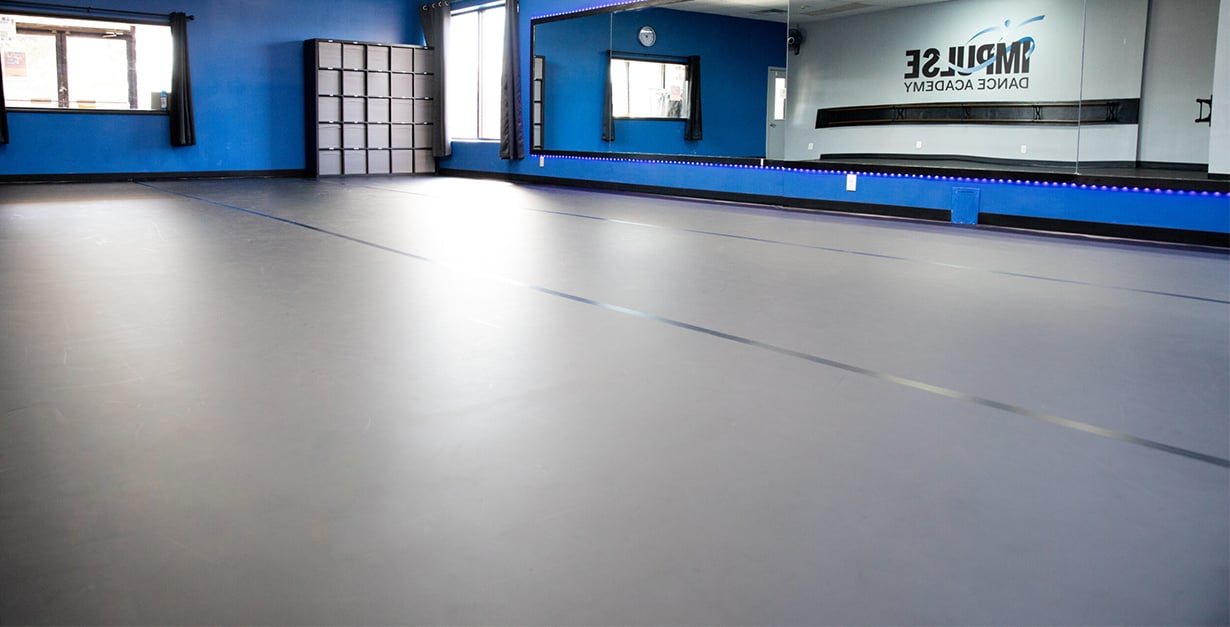
Keeping a studio floor in good condition
Rosco's guidance for studios is to sweep daily with a soft bristle broom or dry duster and to wet clean at least weekly, more often in a busy studio. Use Rosco All Purpose Floor Cleaner for regular cleaning and Rosco Heavy Duty Floor Cleaner for a deep clean. Rosco warns against ammonia, melamine foam sponges and harsh cleaners, which damage the vinyl. Place mats at any street entrance to keep grit off the floor.
More dance floor guides
- Vinyl Dance Floor: A Buyer's Guide for Studios, Stages and Touring
- Marley Floors for Home Practice: A Guide for Dance Teachers
- Ballet Flooring: Choosing a Marley Surface for Ballet and Pointe
- Theatre and Stage Flooring: Marley, Vinyl or a Painted Deck?
- Dance Floor Tape Explained: Seams, Perimeters and Double Stick
- Dance Floor Mats vs Full Rolls: Choosing a Portable Floor
Send us the room size, subfloor and the classes you teach, and we will recommend a surface and quantities.
Floor enquiryDance floor finderFloors swatchbookReferences
- Rosco, Which Rosco Floor Is Right For You? Floor specification charts (v5.1).
- Rosco, Adagio Tour floor installation manual: preparing your substrate, installation, cleaning and maintaining.
- Joel Svendsen, Your Dance Floor Questions Answered, In The Dance Studio Podcast, Rosco Spectrum, 30 March 2023. Listen to The Dance Studio Podcast.
- Brittney Pecor, How Rosco Duètte Transformed A Dance Studio Overnight, Rosco Spectrum, 28 April 2025.
- Rosco Laboratories, Rosco Adagio Floor vs. Marley Floor: Hear The Difference, YouTube.
Photographs and video courtesy of Rosco Laboratories, credited to Rosco. CFATS is the exclusive Rosco agent for Australia and New Zealand.