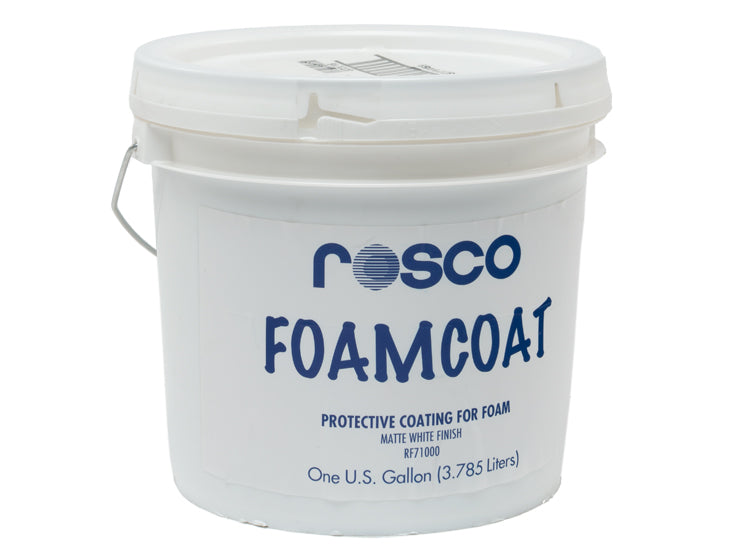

Turn rigid foam into a tough, paint-ready shell
FoamCoat is the industry go-to for hardening XPS, EPS and polystyrene foam into an impact-resistant, sandable, paintable surface — built to survive handling, rehearsals, touring and real-world use.

Most common FoamCoat projects
- Carved foam rocks, cliffs and caves
- Foam brickwork and architectural facades
- Lightweight props that take frequent handling
- Touring scenery needing a durable paint surface
- Exhibition & museum display elements
- Event and retail builds where weight matters
- Foam signage and sculptural pieces
- Seasonal decor and themed installations
Best for — and the alternatives
FoamCoat is best for
- Rigid foams: XPS / EPS / polystyrene
- Creating a hard, impact-resistant shell
- Surfaces you want to sand, carve and paint
- Scenic builds needing durability + paint adhesion
If you need flexibility or adhesion
FoamCoat cures hard. If your build must bend or compress, needs adhesive reinforcement, or you want clear effects:
- FlexCoat → flexible scenic coating (soft props / touring)
- FlexBond → adhesive + coating (mixed materials)
- CrystalGel → clear textures (water / ice / glass effects)
How much FoamCoat do I need?
FoamCoat covers roughly 12–16 m² per gallon, depending on foam texture and coat thickness. Most scenic builds use 2–3 coats for a durable shell.
| Surface area | 2 coats | 3 coats | Notes |
|---|---|---|---|
| 5 m² | ~0.7 gal | ~1.1 gal | Round up if heavily textured |
| 10 m² | ~1.4 gal | ~2.1 gal | Most common small scenic builds |
| 20 m² | ~2.9 gal | ~4.3 gal | Consider a spray / hopper for speed |
| 40 m² | ~5.7 gal | ~8.6 gal | Large walls / multiple pieces |
Carving deep texture? Plan on the lower coverage (12 m²/gal) and round up. Email us your approx. m² and coat count and we'll estimate it for you.
FoamCoat in action
Real workflows and outcomes — projects and imagery courtesy of Rosco Spectrum.

Read the article →

Read the article →

Read the article →
FoamCoat vs FlexCoat vs FlexBond vs CrystalGel
| Product | Best for | Key advantage | When to choose it |
|---|---|---|---|
| FoamCoat | Rigid foam hardening (XPS/EPS/polystyrene) | Hard, durable, paint-ready shell | Rocks, facades, props, impact-resistant scenic builds |
| FlexCoat | Flexible foam / soft props / touring | Tough and flexible (less cracking) | Anything that must bend, compress or take vibration |
| FlexBond | Mixed materials + adhesion + reinforcement | Adhesive + coating in one | Foam-to-fabric, foam-to-wood, layered builds |
| CrystalGel | Clear textures / water & ice effects | Clear build-up for special finishes | Water, glass, slime, ice, translucent effects |
Application, specs & FAQ
How to apply FoamCoat (step by step)
- Stir thoroughly — FoamCoat contains heavy solids; power mixing is recommended.
- Apply to foam by brush, roller or hopper spray gun, depending on texture and speed.
- Build coats — more coats mean more strength and impact resistance.
- Dry between coats — typically 2–8 hours (thickness & conditions dependent).
- Full cure — allow ~24 hours before sanding, carving or painting.
- Finish with Rosco scenic paints (Off Broadway, Supersaturated) or standard acrylics.
Tip: use undiluted for maximum durability; light thinning with water gives smoother coats but reduces toughness.
Technical specifications
- Colour: off-white, matte finish
- Chemistry: water-based, non-toxic, inherently flame-retardant
- Coverage: approx. 150 sq ft per gallon (~12–16 m²)
- Film thickness: approx. 1/16″ – 3/16″ per application
- Dry time: approx. 2–8 hours between coats
- Full cure: approx. 24 hours before sanding / carving / top-coating
- Application: brush, roller or hopper spray gun
- Clean-up: soap and water while wet
- Shelf life: min. 24 months sealed and stored properly
- Compatibility: Rosco scenic paints + most water-based coatings
FoamCoat FAQ
Does FoamCoat melt foam?
No — it's water-based and designed for EPS / XPS / polystyrene.
Can it be used outdoors?
It's water-resistant, but outdoor builds should be finished with paint / top-coat for longer weather exposure.
Can FoamCoat be sanded?
Yes — once fully cured it can be sanded or carved for refined detail.
How many coats?
Most builds use 2–3 coats depending on durability needs.
Can I paint it?
Yes — it gives excellent tooth for Rosco scenic paints and acrylics once cured.
Which Rosco coating do I need?
Most rigid-foam builds use FoamCoat. If you're deciding between coatings, start from what you're trying to achieve:
View FlexCoat
View FlexBond
View CrystalGel
Need more than specs?
The complete guide covers application tips, outdoor best practice, safety notes and full comparisons across FoamCoat, FlexCoat, FlexBond and CrystalGel.
Performance depends on substrate, film thickness, curing conditions and finishing system. For specific compliance requirements, contact us for guidance.
Not sure yet? Order a sample — free for new customers, just pay postage.
Technical data sheet