
Rosco Supersat Paints: The Complete Scenic Paint Guide
A practical, scenic-artist-focused hub covering what Supersat is, why it’s different, how to use it, and where it shines across theatre, film/TV, themed environments, murals and photographic backdrops.

What is Rosco Supersat?
Supersat (Supersaturated Roscopaint) is a concentrated, water-based vinyl acrylic scenic paint designed to be diluted with water (at least 1:1) to create a huge range of finishes—from vibrant opaque colour fields through to transparent washes and dye-like glazes. Because it starts as a concentrate, you can control strength, translucency, and flow rather than being locked into a “straight-from-the-tin” wall paint behaviour.
Rosco positions Supersat as a highly extendible scenic system that remains economical and flexible, and it can also be used as a tint/colorant in other water-based paints, binders, and coatings. (Source: Rosco product page) View Rosco Supersat product info.
Why scenic artists choose Supersat
If you’re painting scenery, drops, props, textures, themed environments—or anything that needs controlled translucency, layered colour, and repeatable results—Supersat is often chosen because it behaves like a scenic tool, not a house paint.
Real-world reasons you’ll hear from painters
- Layering without heavy build: When diluted, Supersat can stay thin on cloth while still building rich colour through layers—useful for painted drops and panto cloths.
- Vibrant pigmentation for washes & glazes: The concentrate format makes it easy to hit translucent colour that still reads “strong” under stage light and camera.
- Versatility across substrates: Used across MDF, ply, plastics, scenic composites, primed plaster walls and more (with correct prep).
- Control: You can push it toward dye-like effects, or pull it back to coverage when you need it.


Want the long-form case studies? Here are the Rosco Spectrum articles used for examples: Ed Reynolds mural work, Panto cloth painting, Themed scenery & props, Distressed walls & floors, Textured photo backdrops.
Key properties & technical highlights
Below is a plain-English breakdown of what matters to scenic painters (pulled from Rosco’s technical description and how the paint is used in the field).
Core technical points (Rosco)
- Type: Vinyl acrylic (water-based) scenic paint concentrate.
- Finish: Flat / matte.
- Dilution: Designed to dilute at least 1:1 with water; can also dilute with clear acrylic glaze or a combination (Rosco notes heavy dilution may reduce binder strength, and glaze can help restore adhesion/flexibility).
- Application methods: Brush, roller, spray (thin, uniform coats; maintain wet edge).
- Cleanup: Soap and water.
What makes it feel “different” in scenic practice
- Controlled transparency: You can chase dye-like intensity while staying water-based (useful for glazing, aging, scenic washes).
- Acts as a tint/colorant: Use it to shift other water-based paints and mediums without buying dozens of pre-mixed colours.
- Flexible system approach: Rosco states the binder is engineered for adhesion/durability/flexibility—especially relevant when you’re painting surfaces that move or get handled.
- Economy from extendibility: Concentrate means your “finished paint volume” can go a long way when used correctly.
How to use Supersat (the way scenic artists actually work)
1) Mixing & dilution (practical starting points)
- Opaque colour fields: Start around 1:1 (paint:water) and adjust. Build in thin coats rather than one heavy coat.
- Classic scenic wash: Push past 1:1 until you get the translucency you want. Work in layers to build depth.
- Glazes & dye-like effects: Use higher dilution and/or add clear acrylic glaze to keep adhesion and flexibility while staying translucent.
- As a tint/colorant: Add small amounts into other water-based paints/binders/coatings and test on the actual substrate under your lighting/camera.
Tip: If you’re going very watery, Rosco notes that extremely high water ratios can reduce binder strength—use a clear acrylic glaze medium when you need the translucency but still want the paint film to “hold together.”
2) Brushwork vs rolling vs spraying
- Brush & sponge: Ideal for scenic texture, mottling, scumbling, aging and detail work. Great for layering and keeping edges organic.
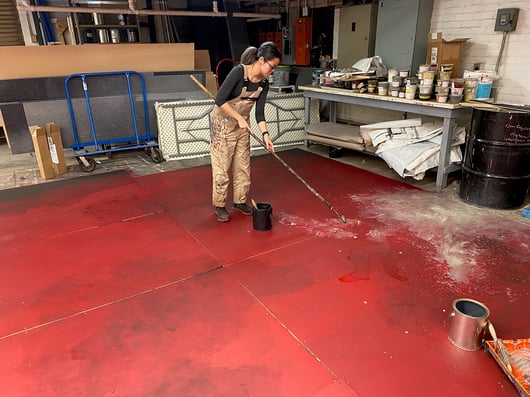
- Rolling: Best for consistent base coats. Use quality rollers, overlap strokes, keep a wet edge, and change direction to avoid patterns.
- Spraying (touch-up gun / HVLP): Perfect for even glazes, stencilled texture and breaking up “brush identity.” Test dilution and nozzle setup on scrap first.
Where Supersat shines (best-use applications)
Theatre drops, backings & cloth painting
- Layer colour without heavy paint build that can stiffen or crease fabric.
- Use translucency to create depth, atmosphere, and painterly transitions.
- Great for scenic education environments because students can see how dilution changes behaviour and colour strength.
Example: Panto cloth course project.
Props & themed scenery
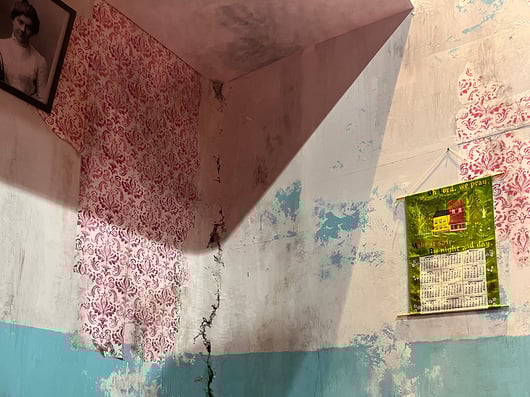
- Faux finishes: wood grain, rust, grime, oxidisation, patina, stone, plaster, aged signage.
- Micro-detail work: labels, small scenic accents, character details.
- Layered washes are especially useful for “age everything” passes (Raw Umber / earth tones are common picks).
Example: Themed scenery & props.
Murals & large-format painting
- Strong tonal values and easy layering are a recurring reason muralists stick with Supersat.
- Build depth through multiple passes while keeping flow manageable.
Example: Ed Reynolds mural work.
Textured photography backdrops
- Use Supersat with glaze/water in multiple layers to create depth, mottling and specular interest.
- Add inert textures (e.g., sand/sawdust) into layers when you want a more tactile surface (always test for shedding and seal appropriately).
Example: Textured backdrop workflow.

Surface prep, priming, sealing & topcoats
Surface prep (non-negotiables)
- Clean, dry, grease-free: Dust, oils, release agents and polishing residues will ruin adhesion.
- Porous surfaces: Prime/seal first (Rosco references Tough Prime for many porous substrates; plaster should be sealed with an appropriate primer/sealer before scenic priming).
- Test on the real substrate: Supersat behaves differently on MDF vs ply vs primed wall vs plastics.
Source guidance: Rosco Supersat application & prep notes.
Do you need a clear coat?
It depends on handling, abrasion, and whether the surface will be cleaned. Scenic painters often leave many scenic finishes uncoated to preserve “paint truth” and avoid changing sheen. For high-touch props, floors, or public-facing installs, a compatible scenic topcoat can make sense—but always test because any clear can shift sheen and deepen colour.
- Don’t guess: Test your complete stack (primer → Supersat layers → optional topcoat) under the exact lighting.
- Match your finish goal: If you want dead-flat, choose a flat system end-to-end (and test—some “flat” clears aren’t truly flat on every substrate).
Scenic-artist FAQs (the questions people actually ask)
How far can I dilute Supersat?
Rosco describes Supersat as designed to dilute at least 1:1 with water and further for translucent effects. For very high dilution, use a clear acrylic glaze medium (or a water/glaze blend) so the paint film keeps good adhesion and flexibility.
Will it streak or roller-mark on large flats?
Any scenic paint can telegraph tool marks if you let edges dry or if the substrate is unevenly sealed. Use thin coats, keep a wet edge, overlap strokes, and change roller direction. On large areas, consider spraying your glaze layers to unify the finish.
Is Supersat “better” than other scenic paints?
“Best” depends on the job. Supersat’s standout value is the concentrate format and how far it can stretch across techniques—opaque coverage, tints, glazes, and dye-like washes—without switching systems. If you need fast, consistent coverage only, other scenic paints can be more “ready-to-go.” If you need maximum control and range, Supersat is hard to beat.
Can I use it as a tinter/colorant?
Yes—Rosco states it can be used as a tint in other water-based paints, binders and coatings. This is one of the easiest ways to keep colour control in-house without stocking endless pre-mixed colours.
What’s the best way to match colours?
- Start with the Supersat palette and intermix. Record ratios by weight (not “brush dips”).
- Always approve under the intended light/camera (stage light can desaturate certain pigments, camera sensors can shift greens/blues).
- Make a drawdown card on your actual primed substrate, not just paper.
Can I paint flexible or difficult surfaces?
Rosco notes Supersat is formulated with a binder intended to provide adhesion/durability/flexibility even on difficult surfaces (they specifically reference Rosco Projection Screens and Rosco Dance Floors). In practice: prep properly, test adhesion, and avoid overly brittle “all-water” mixes if the surface flexes—use a glaze medium when needed.
How many coats do I need?
It depends on substrate, colour choice, dilution ratio, and whether you’re building opacity or glazing. Scenic painters usually build looks through multiple thin passes rather than chasing full coverage in one hit.
Can I use Supersat for ageing and distressing?
Absolutely—this is one of its strongest use-cases. The ability to thin down and build transparent layers makes it excellent for grime, smoke, water staining, patina and “time passes” effects.
Supersat paint chart (quick reference)
If you want a fast visual reference for colour family and dilution strength, use the chart below (and always test a physical sample for final sign-off).

Coverage calculator
Work out how much paint this job needs
Enter your wall, floor or cyc dimensions and get the quantity in gallons and tins, using Rosco's published coverage figures. It covers 18 Rosco products and handles the cove geometry on a curved cyc.
Open the paint coverage calculatorNeed help choosing colours, quantities, or the right system?
Talk to us
Tell us what you’re painting (drops, flats, props, murals, backdrops), your substrate, and the finish you’re aiming for—and we’ll point you in the right direction.
Further reading (case studies & techniques)
- Why Artist Ed Reynolds Believes Rosco Supersat Is The Best Mural Paint
- Scenic Art Students Transform Panto Cloths with Rosco Supersat Paints
- Creating Realistic Themed Scenery & Props Using Rosco Supersat Paints
- Distressed Walls & Floors – The Art of Faux Deterioration on Stage
- Sophisticated Photography Backdrops Created With Painted Textures
- Rosco Supersaturated Roscopaint (AU) – features & specifications